|
Keeping you informed about community-led research - for a more inclusive and equitable Aotearoa.
|
|
|
|
|
|
Nau mai haere mai
Whakatairangatia i te mana o te rangahau ā-hāpori me te mahi tahi
Community and whānau aspirations for research. |
|
|
|
Kia ora e te whānau,
As we reach the end of another full and fast-moving year, many of us are beginning to look toward the summer break — a chance to rest, reconnect, and prepare for the possibilities ahead. At Community Research, we’re feeling grateful for the mahi we’ve shared with you in 2025, and excited about the projects already taking shape for 2026. There is so much potential in the year ahead, and we look forward to continuing this journey with you.
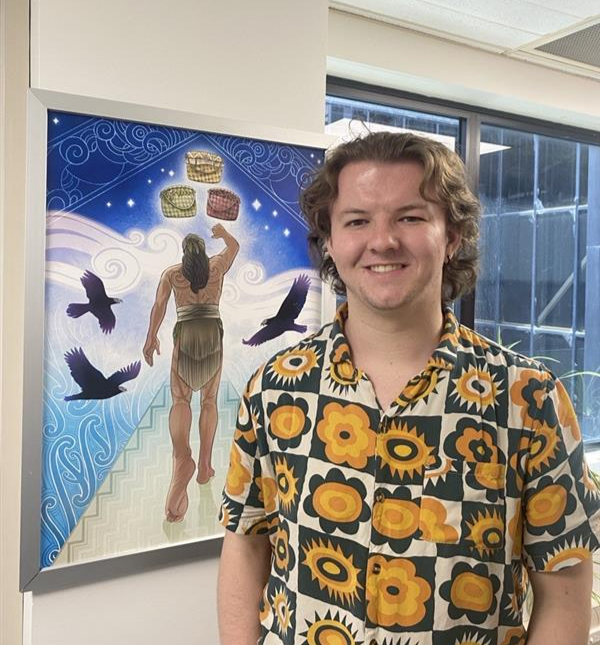
We’re delighted to welcome Henry, our new intern, who has joined us for the summer. Henry will be supporting a key project and getting to know the sector, so please join us in giving him a warm welcome.
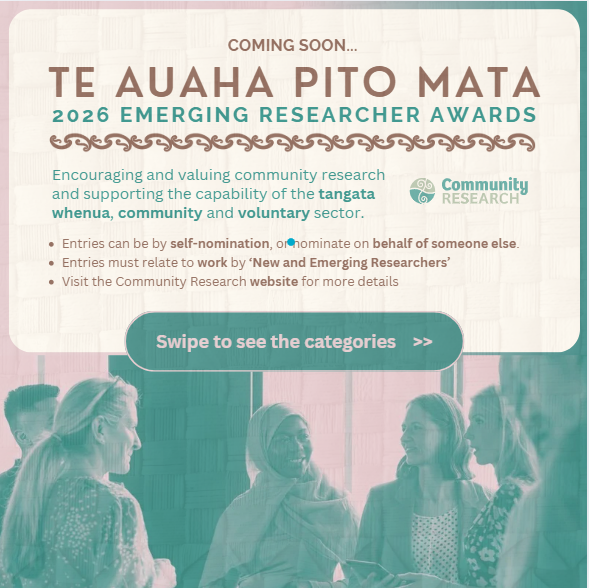
A reminder that Te Auaha Pito Mata Awards nominations are now open. This is your chance to recognise emerging researchers whose work uplifts diverse voices and strengthens community-led knowledge. We’d love your help to spread the word through your networks.
We are currently preparing to respond to Stats NZ’s "Modernising the Census" consultation. Community Research is committed to equity and inclusion. This includes ensuring that smaller and ethnically diverse communities remain visible in national data. Many communities have shared concerns about their visibility being reduced through the proposed changes. Our mahi aims to support visibility, and voice for diverse Ethnic communities in response to the proposed changes.
We’ve also been enjoying deeper collaboration with the organisations we share our office space with. A highlight was hosting Volunteering NZ’s International Volunteers Day webinar on 5 December, which brought together thoughtful insights and sector voices. We’ll be sharing the recording with you shortly.
As always, thank you for being part of our community. Your support, advocacy, and aroha continue to strengthen the impact of community-led research across Aotearoa.
Meri Kirihimete! Wishing you a relaxing, safe and happy holiday period.
ngā mihi o te tau hou, Lorna
|
|
|
|
| | Welcome to Henry GrowcottHenry is completing his final year in a Master of Political Philosophy and Economics at Te Herenga Waka Victoria University of Wellington. For his internship at Community Research, he is scoping a potential Community Research project about 'Equity and Participatory Democracies' which has a strong crossover with his thesis work. Henry has a passion for political philosophy. His thesis involves examining the responsibilities people in a country have to each other based on the benefits gained from living in a community. Similarly the responsibilities that people in power have to those that give them that power and what criteria constitutes failure to uphold this social contract.
Post graduation, Henry hopes to work in the public sector. |
|
|
|
Te Auaha Pito Mata Awards 2026 - Nominations are open! |
|
|
|
| | Nominations are now being accepted for our Te Auaha Pito Mata Awards. There are four awards categories researchers can be nominated for:
- Tangata Whenua community researcher (for Māori researchers)
- Ethnic community researcher (for Ethnic researchers)
- Pasifika community researcher (for Pasifika researchers)
- Community researcher/evaluator
Plus the ‘Billie Award’ that is bestowed in recognition of strengths based research or evaluation.
These Awards provide an opportunity to celebrate the recipients, their research projects, community research and diverse ways of knowing. |
|
|
|
Guest Judges
Nominations for each award category will be reviewed by guest judges from that community. We will be announcing our impressive panel of guest judges in January 2026! Stay tuned.
An invitation to partner with us
There are still opportunities for partners to stand with us in celebrating the next generation of community researchers.
Supporting the Te Auaha Pito Mata Awards is a meaningful way to uplift emerging voices and the research that strengthens communities across Aotearoa. It's also a great opportunity for the research sector to connect and support the next generation of researchers.
👉 Keen to get involved? Learn more here about sponsorship opportunities and how you can be part of this kaupapa, or contact Lorna directly. |
|
|
|
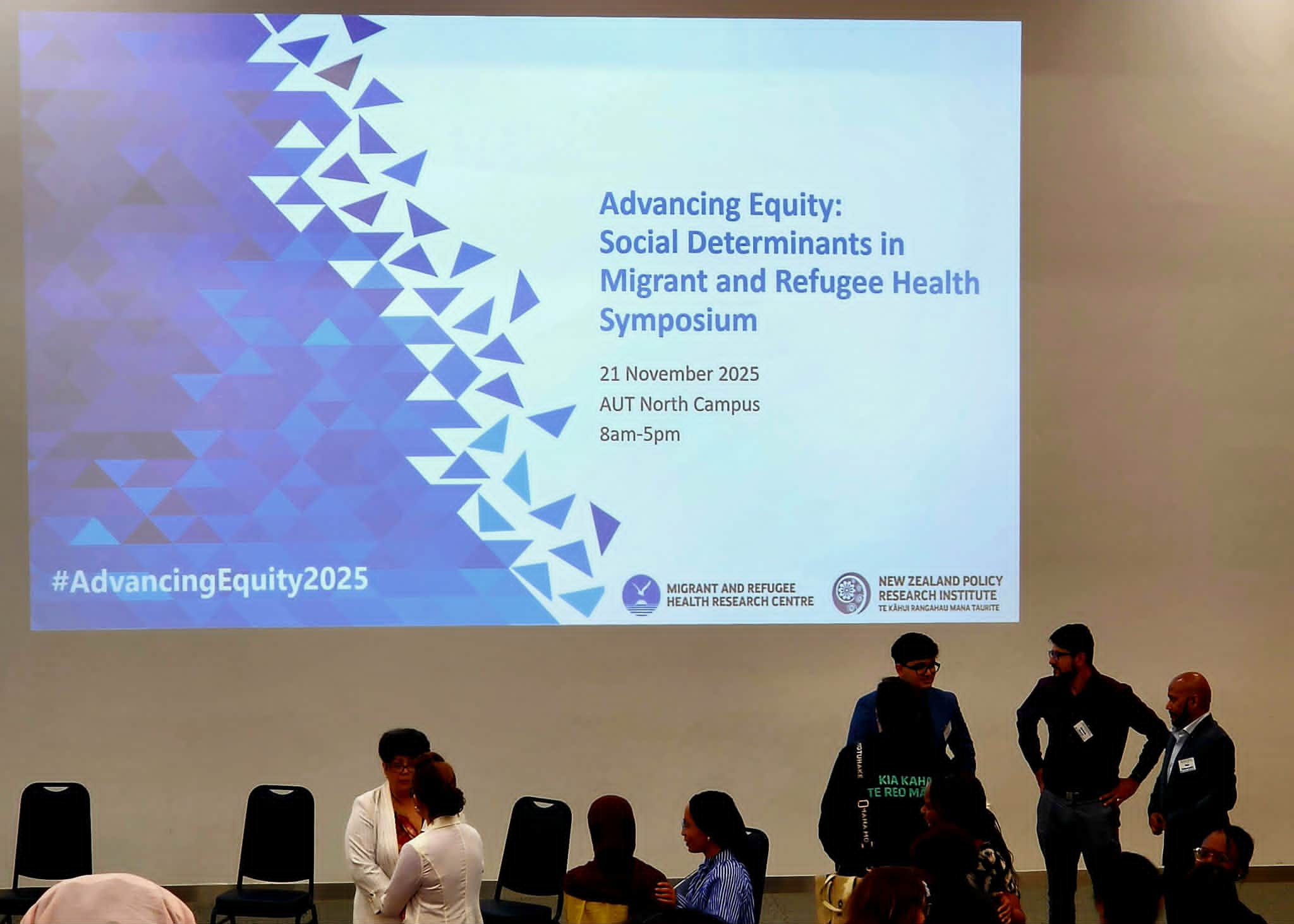
| Advancing Equity: Social Determinants in Migrant and Refugee HealthBev (and volunteer Isaac) had the pleasure of attending the Advancing Equity: Social Determinants in Migrant and Refugee Health Research Symposium in Tāmaki Makaurau last month. The symposium was a wonderful opportunity to catch-up with old friends and make new connections, hear about and be inspired by research and community initiatives, and represent at the Community Research stall. Congratulations and thanks to the AUT Migrant and Refugee Health Research Centre (MRHRC) and the New Zealand Policy Research Institute (NZPRI)! |
|
|
|
| | Ethnic, former Refugee and Migrant researcher Tautoko network
A heartfelt thank you to everyone who has supported and been part of the Ethnic former Refugee and Migrant Tautoko Network and activities this past year. It has been a real privilege and such an enjoyable journey to connect with you all as we evolve this space together in a way that is of value, increases our visibility and provides opportunities for connection across ethnically diverse community researchers and allies.
Outcomes of the 26 November Tautoko session At our final Tautoko session for this year, we discussed the findings from the feedback survey (so far) and ideas for 2026. It is not too late to take a few minutes to provide feedback about the Tautoko Network and sessions here: EfRM Tautoko feedback form Interim findings and discussion outcomes include that we: - continue with two-monthly Tautoko sessions as currently run
- consolidate the Network and use it as the focus for updates and upcoming events (including content from Network members)
- continue with Tautoko session attendance being open to both Network and non-Network researchers and allies
- create a dedicated EfRM Tautoko Network page and focus on branding, visibility, and promotion with increased reach
- create opportunities for more interaction such as the potential for local area meet-ups to be organised.
Ko koe, ko au, ko tāua - You, me, we. (Together in unity) Ngā manaakitanga Bev and Eve |
|
|
|
Modernising the Census and meeting the needs of ethnically diverse communities
Based on expressions of interest received, Bev and Eve are progressing the mahi to share whakaaro and kōrero (thoughts and discussion) about the modernising of the Census - strengths, challenges and opportunities to support responses to the call for submissions by StatsNZ regarding its proposed content and data collection approach. The new admin-data-first census model has three elements: use of administrative data, a new annual sample survey (Census Attribute Survey), and tailored solutions. The mahi involves:
- an online awheawhe/workshop, 3.30-5.00pm Monday 8 December to identify key/common features that can be included in a submission about the StatsNZ Modernising the census approach and how it can meet the needs of ethnically diverse communities. We started with some preliminary draft statements to build upon and iterate.
- soundboard the outcomes of the online awheawhe with experts in this space to evolve the template paragraphs.
- generally share the resulting draft paragraphs and text as a resource for submission makers - which will also contribute to the submission that will be made by Community Research.
Submissions to StatsNZ must be provided through their web portal and close 5:00pm on Friday 19 December 2025.
|
|
|
|
Upcoming New Special Collection - Good With/In Games
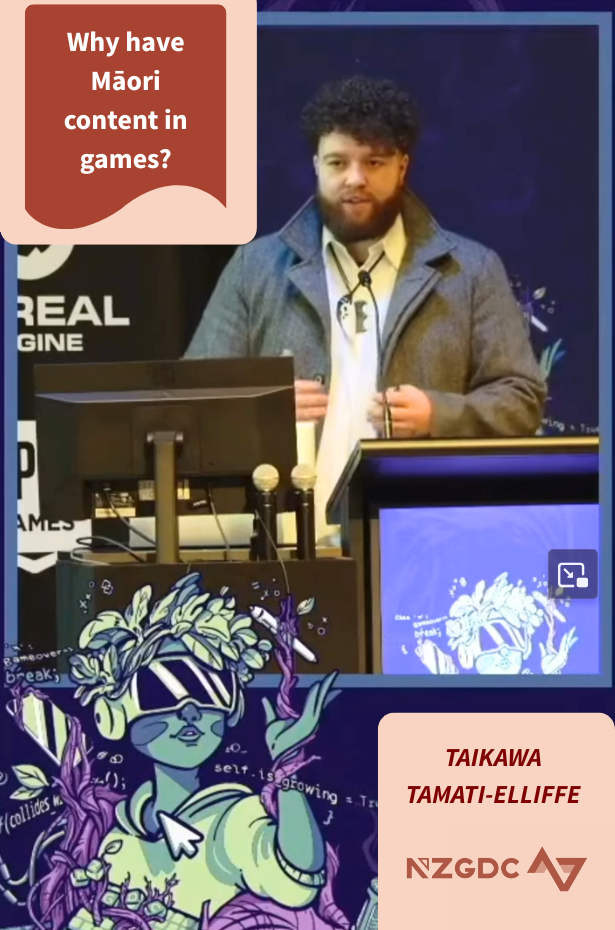
Community Research is excited about a new collaboration in the name of diverse community-led research. We're partnering with the New Zealand Game Developers Association(NZGDA) to launch a new special research collection: 'Good With/In Games'.
Games play a significant role in shaping society, and creators have the power to use them to build a more inclusive and connected world. Here in Aotearoa, our game development community includes many developers, researchers, students, and players dedicated to exploring social good, equity, wellbeing, and diversity through games.
Each year, the NZGDA Conference showcases this rich community-led knowledge and innovation. Aligned with Community Research’s vision for an equitable, engaged, and inclusive Aotearoa informed by community knowledge, this new partnership will make talks and insights on social impact in games available year-round on our website.
|
|
|
|
| The principles of the talk work well for lots of sectors! |
|
|
|
Research Scholarships for Marsden-funded project “Reduce, reuse, repair”
Key details
Stipend: $22,000 (plus fees and fieldwork support)
Study level(s): Postgraduate (research)
Subject area(s): Geography, Planning, Māori Studies, Design, Anthropology, Sociology, Business, Environmental Studies, Environmental Management, or related disciplines
Closing date: December 18th 2025
Contact: Professor Kelly Dombroski, K.Dombroski@massey.ac.nz
Applications are invited for two Research Master’s Thesis Scholarships at either Massey University or University of Canterbury starting in February 2026.
The successful candidates will work with Professor Kelly Dombroski (Massey University) and/or Dr Matthew Scobie (University of Canterbury), on a Marsden funded project, ‘Reduce, reuse, repair”. This research explores how community organisations help people to work together to move up the waste hierarchy and reduce waste. The successful candidates will focus on specific topics developed in partnership with Para Kore and Repair Network Aotearoa.
Example topic areas proposed by community partners include:
-
researching traditional repair or restoration practices in Te Ao Māori
-
the traditional design of everyday tools and equipment in relation to te taiao
-
contemporary responses and strategies for addressing wasteful product design from a Māori perspective
-
Te Tiriti o Waitangi perspectives on equity in access to durable, repairable goods.
We strongly encourage applications from:
-
Students interested in reducing waste and sustainability
-
Māori students who have an interest in te taiao and te reo
-
Students who are interested in, or have experience in, working with Māori communities or community organisations in practical contexts
This scholarship provides an exciting opportunity to contribute to meaningful research working in partnership with community organisations.
Eligibility: The successful candidate will have an undergraduate degree in a relevant discipline. University requirements are for students to have a B+ GPA or demonstration of equivalent competency.
Note on degree structure: This is a research focused scholarship, so will most likely take the form of a 180 point master’s with 60 points of course work and a 120 point research thesis (e.g. Master’s of Arts at Massey). Other degree structures will be considered depending on the applicant’s previous degree and the discipline they hope to enrol in. Applicants with honours degrees, postgraduate diplomas, or four-year degrees can sometimes go straight into a one-year research thesis with no coursework.
Materials required for application: Applicants should submit:
- their academic transcript from their undergraduate degree,
- their CV, and
- a short cover letter explaining their interest in the project and why they want to do a master's thesis.
Applicants shortlisted will be invited to a short online interview in late January 2026. Enrolment dates close in early February for 2026.
|
|
|
|
| |
𝗪𝗵𝘆 𝗟𝗚𝗕𝗧𝗤+ 𝗗𝗮𝘁𝗮 & 𝗗𝗘𝗜 𝗙𝗿𝗮𝗺𝗲𝘄𝗼𝗿𝗸𝘀 𝗠𝗮𝘁𝘁𝗲𝗿 𝗳𝗼𝗿 𝗕𝗲𝘁𝘁𝗲𝗿 𝗣𝗼𝗹𝗶𝗰𝘆
This seminar is hosted by NZPRI and the AUT Rainbow+/Takatāpui Research Group.
📅 19 January 2026
🕒 Time: 3:00–5:00pm (light refreshments to follow)
📍 Location: AUT City Campus, Te Iringa (WG308), WG Building, 2 Governor Fitzroy Place
💻 Online option: TEAMS link available
This timely seminar brings together leading experts to unpack why robust LGBTQ+ data and strong Diversity, Equity and Inclusion (DEI) frameworks are essential for developing fair, evidence-based policy.
-Prof Christopher Carpenter (Vanderbilt University, U.S.) will explore global progress — and ongoing challenges — in counting and understanding LGBTQ+ communities.
-Prof Gail Pacheco (HRC) will discuss why weakening DEI commitments poses real risks in today’s increasingly diverse workforce. -The session will be facilitated by Prof Elizabeth Du Preez, with plenty of opportunity for open Q&A.
All welcome — join the kōrero and be part of the discussion on how Aotearoa can build more inclusive, equitable policy for everyone.
|
|
|
|
| |
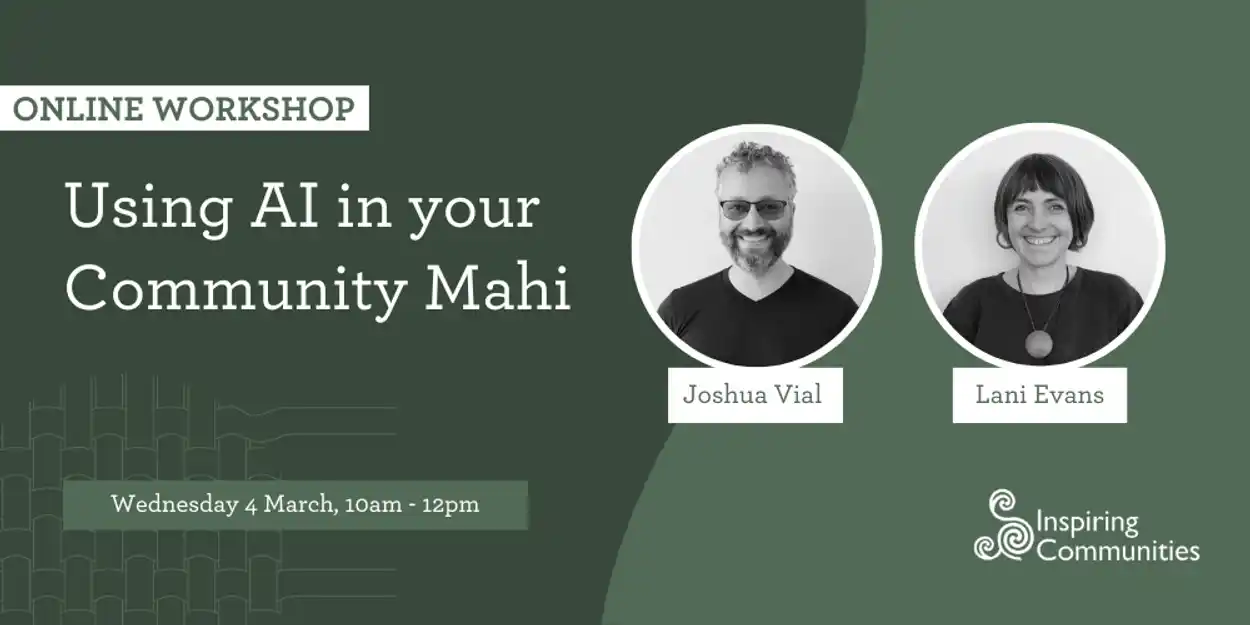
Using AI in your Community Mahi
🗓 Wednesday 4 March
🕙 10:00am – 12:00pm
AI is moving fast, and it's already shaping the way we work in community. The recent Demystifying AI webinar highlighted that we need safe and practical ways to start using it for good, while staying mindful of ethics, bias and privacy issues that can trip us up.
Join Inspiring Communities for this practical workshop from Lani Evans and Josh Vial of Fundsorter where they will walk you through useful ways to bring AI into your mahi and answer all your techy and tricky questions along the way.
|
|
|
|
| |
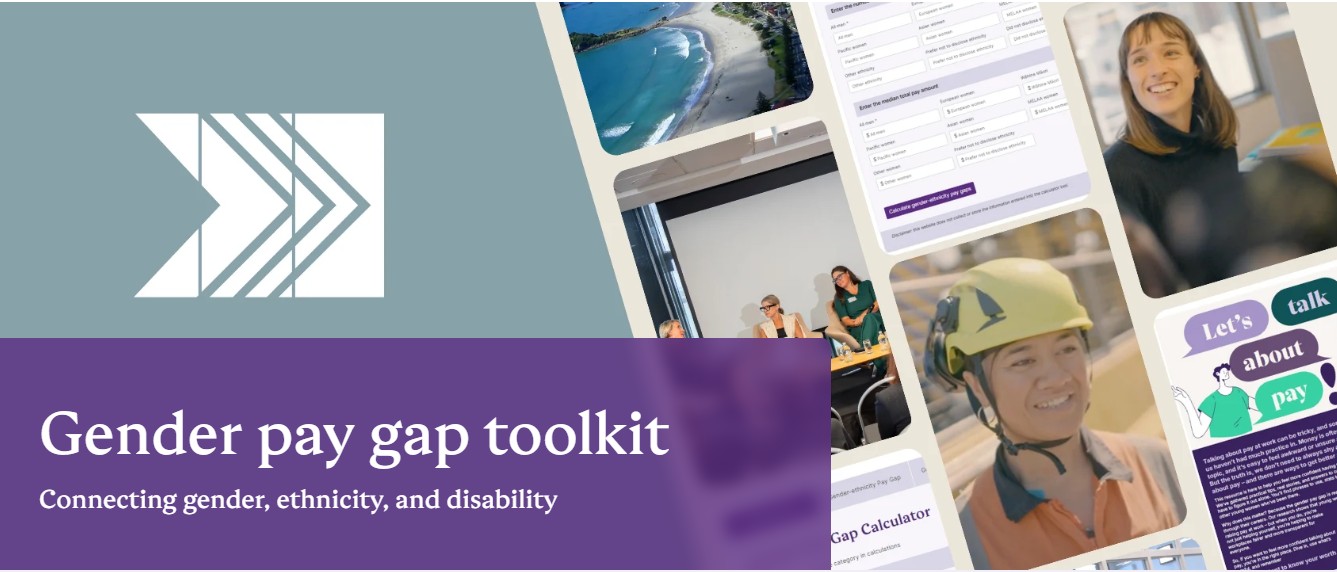
Gender pay gap toolkit
Connecting gender, ethnicity, and disability
Every woman’s story is different, but the message is always the same - let’s take action to close the gender pay gap. Voices are loud and clear in this video 🗣️💜
Manatū Wāhine | Ministry for Women are expanding the Gender Pay Gap Toolkit to calculate gender-ethnicity and gender-disability pay gaps means that all businesses and organisations can take meaningful and practical steps to support their women employees and work towards closing the gap.
They’re committed to supporting the young women of Aotearoa, and alongside YWCA we developed a resource for young women to help them have confident conversations about pay.
This also means helping small and medium-sized businesses measure and understand their pays gaps with a new resource offering practical, tailored guidance.
No matter how old you are, where you come from or what sized organisation you’re in, change happens when we act ⭐
➡️ ➡️ Explore the toolkit and contribute to building workplaces where all women are valued equally.
|
|
|
|
| |
Cooperatives UK has published an excellent guide, possibly one of the first for organizations to take action toward a neuroinclusive boardroom.
When it comes to promoting people with special characteristics such as neurodiversity, such efforts are often dismissed as token practice. But what if there are companies that genuinely wish to give neurodivergent individuals a chance to become board members? This guide is designed to help boards create practices that encourage the recruitment and retention of neurodiverse members while maintaining high standards in governance.
|
|
|
|
'Health of Migrants and Refugees' webinar series: 'Catalyzing research evidence exchange between Chile and New Zealand.'A six-part webinar series running through to May 2026 exploring migrant and refugee health through a trans-Pacific lens. Despite geographic distance, Chile and Aotearoa New Zealand share key parallels in healthcare systems, social policies, and public health challenges, making this a rich opportunity for comparative learning and collaboration. - Webinar 1: held 17 Sep 2025 - recording
Drivers of vaccine access and acceptance among migrant and refugee populations in New Zealand and Chile: Evidence-based lessons and challenges. - Webinar 2: held 15 Oct 2025 - recording
Migrant nutritional health and food insecurity in New Zealand and Chile: Evidence-based lessons and challenges - Webinar 3: held 12th Nov 2025 - recording
Mental health and wellbeing among migrant and refugee communities in New Zealand and Chile: Evidence-based lessons and challenges - Webinar 4: NZ: 11th Mar 2026 @ 12pm
Lessons learned from the COVID-19 pandemic experience among migrant
populations in New Zealand and Chile - Webinar 5: NZ: 15th Apr 2026 @ 11am
Bodies, sexuality and gender issues in healthcare among young migrant populations in New Zealand and Chile: Evidence-based lessons and challenges - Webinar 6: NZ: 13th May 2026 @ 11am
Sense of self and coping strategies towards loneliness among migrant populations in New Zealand and Chile: Evidence-based lessons and challenges
Register for the remaining webinars here. |
|
|
|
| |
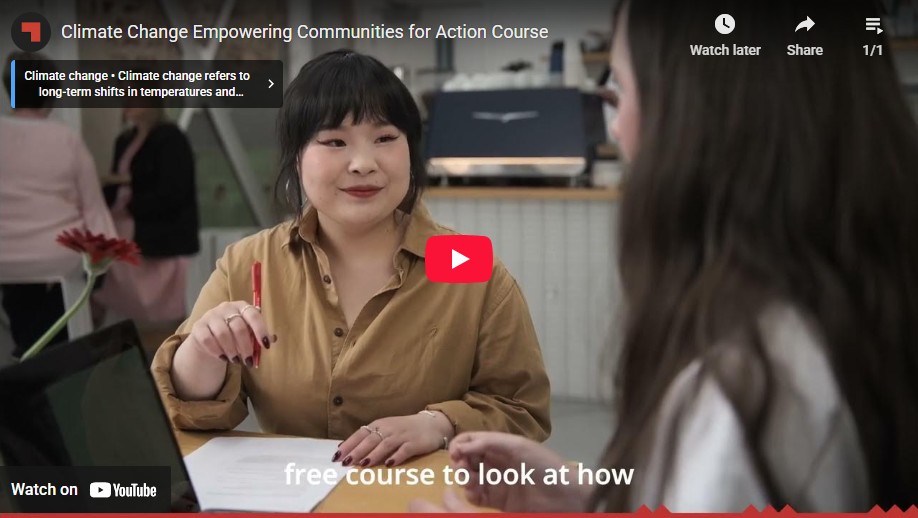
Climate Change Course: Empowering Communities for Action
Get ready to make a difference with this free online climate change course, built by University of Canterbury in partnership with Christchurch City Council and Future Curious. Deepen your understanding of the various perspectives on climate change, and explore practical strategies to take meaningful action.
Climate change is one of the biggest challenges of our time — a complex “wicked problem” that affects our communities, environment, and way of life. It can feel overwhelming, but every action counts, and there are practical steps you can take to make a meaningful difference.
In this free online course, you'll learn what's happening, why it matters, and how you can take a stand. You'll explore scientific and Indigenous perspectives on climate change, and become empowered to contribute to wider community climate action.
Now is the time to act — and this course shows you how to turn knowledge into action.
|
|
|
|
| |
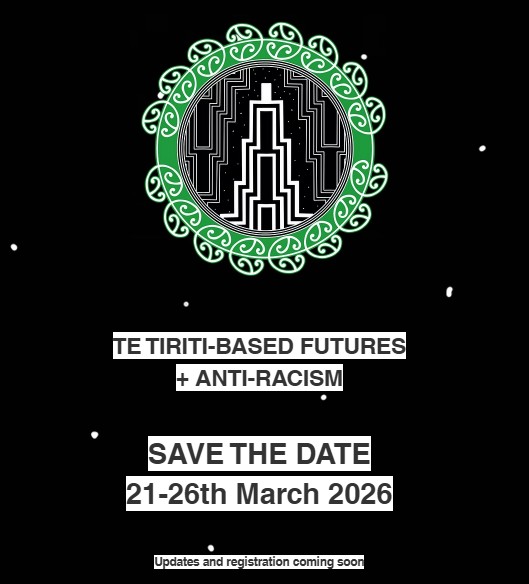
HEI KANOHI MATAARA, HEI RINGA WHITI Eyes wide open , ready for action 21-26th March 2026
Registrations open Wednesday 10 December |
|
|
|
Our vision is a more equitable, engaged and inclusive Aotearoa informed by community knowledge.
Ko ta mātou whakakitenga he Aotearoa e tōkeke ana, e whai kiko ana, e whakamohio mai ana e te matauranga hapori.
Our Commitment:
We provide our services free of charge to support tangata whenua, and the voluntary and community sectors. Community Research is a registered charity, sustained by donations and grants.
Your Support Matters:
If you value our work, please consider making a donation. Your contribution helps us continue to foster a more connected and informed Aotearoa. |
|
|
|
|
|